
the flower's gaze
a wild bouquet of late summer tenderness (& a flower gazing practice session)

To begin: A heartfelt thank you to those of you who chose to receive the very first dark moon letter in the real mail from me. A mysteriously feral process unfolded in the making of that letter. My office exploded into a chaotic scape of pressed flowers, paper clippings, melted beeswax, gluesticks, with walnut hull ink spilled on all surfaces. I became possessed by the process, and your participation, dear supporter of my newsletter, is what allowed me to go so deeply into that whirling beauty portal.
Some moon letters went as far as Finland and Australia. After dropping them at the post office, over that following week I imagined the letters landing in each mailbox with a curious luminosity, as one thread in a vast web. Once the letters left my hands, they dissolved into pure mystery. That is the magic I have longed for.
The second edition of the dark moon letters will be arriving to mailboxes after the fall threshold in late September. A new mystery is brewing.
If you are a paid subscriber and would like to receive the next dark moon letter, please make sure I have an updated mailing address by 9/15 (no need to re-send your address if it hasn’t changed!). Thank you again for your support and delight in this real-mail mystery experiment. It is very special to me.


and now onto this newsletter’s wild bouquet I’ve gathered for you…
the below newsletter is free for everyone, with the recorded class and practice session at the very end for paid subscribers. I hope there is a little flower tucked into this bouquet for every one of you who reads it.
the flower’s gaze: teachers of praise
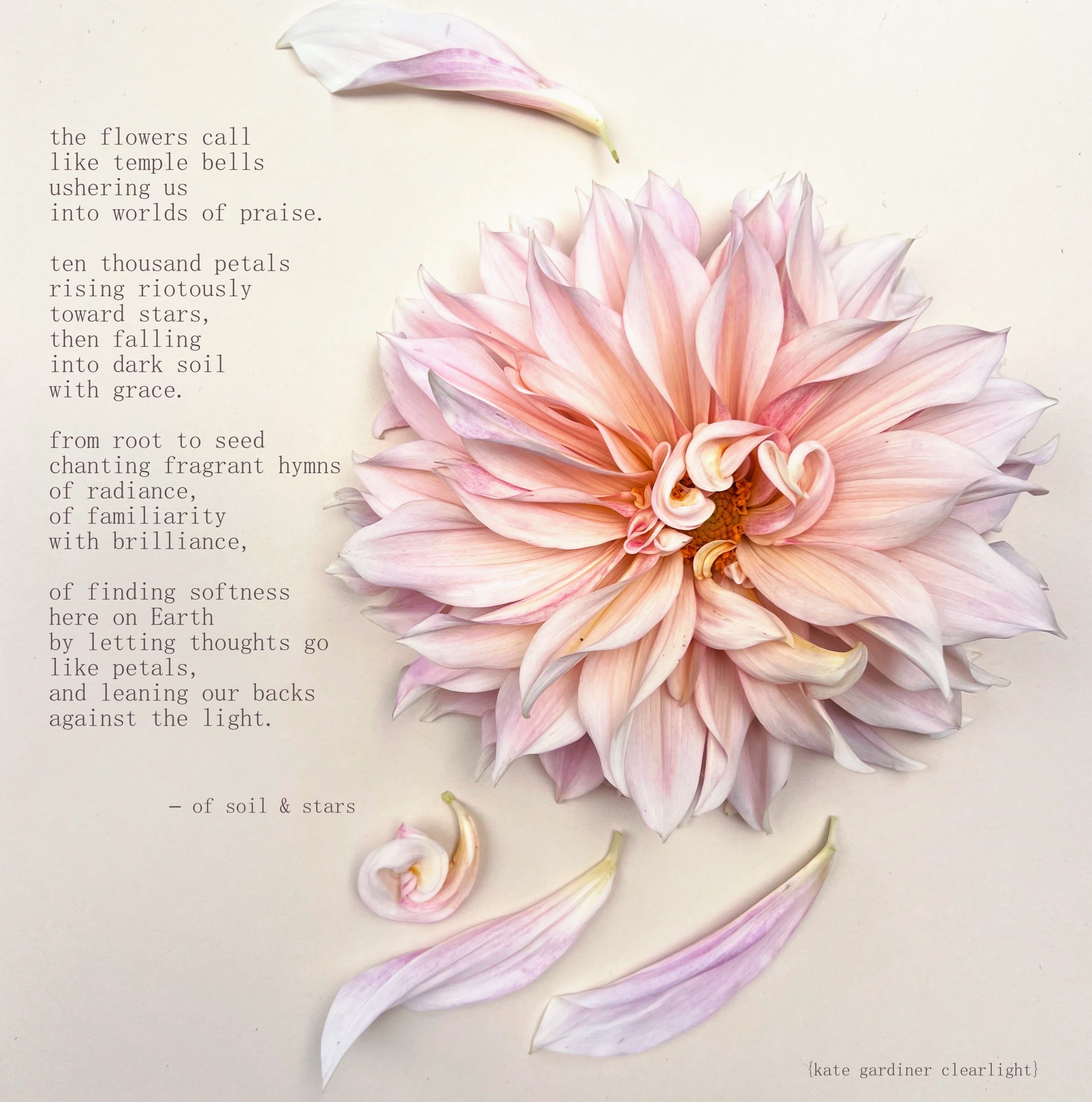
Dear Late Summer, you are the tenderness of every beloved thing wrapped into one gold-drenched stretch of time. The wild meadows and the garden have reached their fullest expression of tangled aliveness. And here we are together, in this great work of flowering, the conjuring of seeds, the August-crowned joy of completion, when the flowering happens effortlessly, and madly.
As if it all wasn’t tender enough, it was my 40th birthday earlier this month. On the day of my birthday, it was the full moon. I cannot remember the last time this happened, nor can I conceive of a more numinous gift to receive. I gazed at the huge golden moon that night and said Yes, Mystery, I have received your message. And I will try my very best to pass it along.
Upon receiving that gift, I was inspired to arrange this bouquet to share with you, including a contemplative audio class and practice session at the end, which I hope might feel a bit like a gift. I recorded the first session in the days before the full moon, and the practice session a few days after. In between recording the two parts, I went camping in the wilderness with my partner and our dogs, Lilikoi, Santo, and Deva.


Beauty, yes. And yet every year I spend my birthday in a state of heartache. I know I am not the only one who experiences birthday despair. The preciousness of life is just so clear on that day. My deepest longing is to love this world and all of its inhabitants, without one exception. And yet I may never fully live that longing into this world. There are so many things I feel horrified and outraged by. Loving this world fully is a difficult aspiration in these times, and it is my life’s most tender work in progress.
All the unexpressed love wells up from the depths when I am confronted with my own life’s impermanence. As though there is just no more time to waste. In the wake of that divine tidal wave, I am humbled by the beauty that has made my life. I could never possibly say thank you enough in one lifetime. And perhaps that is the whole point.
the knowledge of impermanence
that haunts our days
is their very fragrance.
we in our striving think we should last forever,
but could we be used by the Divine
if we were not ephemeral?
(Rilke, Sonnets to Orpheus)
As the flowers in late summer tell us, there is simply no time to hold back our love. The time to speak about our love is now, even if the words come out in a tangled mess. In fallen petals and shaggy seed heads. A million motions of praise, cast upward and downward and every which way.
what a flower knows
Recently I was driving and caught sight of one of those feral roadside wildflower arrangements, the kind that arrive in late summer. It was perfect, and wildly passionate, such a perfect display of unbound creative expression. Without a thought, something beautiful escaped my mouth, as though I had been holding a butterfly in there and finally set it free. I heard myself speak words of awestruck praise, directed at those flowers, meant for Earth herself to hear them. They flowed out of me as naturally as breath.
Tears came to my eyes as I recognized my own willingness to love and cherish this world, to be moved by beauty and thereby give birth to more. You make it so easy, I whispered to the flowers as I drove. You make it so easy… to love.
I remembered then what I have suspected for years now, which is that the flowers, those 100 million year old enlightened forces of beauty rising directly out of dark Earth, are indeed our teachers. Teachers of what? The flowers are literally training us to love the world more. By showing up in their most exalted, generous, brilliant forms, they effortlessly invite us to do the same. They are the wise old sages we have been searching for.
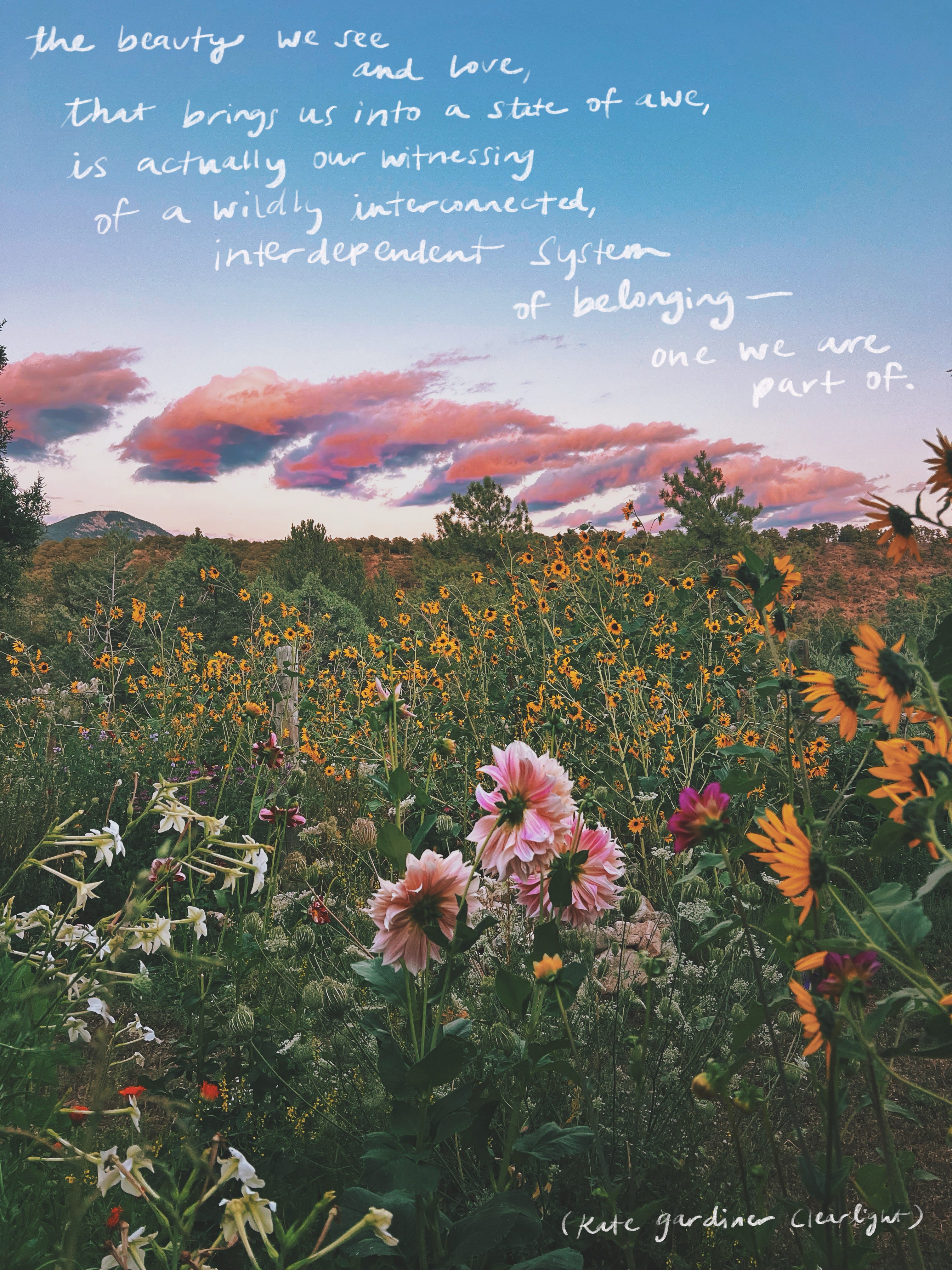
In a world full of unthinkable suffering and injustice, flowers somehow make it possible for us to speak words of praise through it all, as though they are our training wheels for loving this world. As though pain and beauty were never separate to begin with. A flower’s beauty invites us to recall our own true nature — which is awe, and profound belonging, and supreme care for everyone.
By encouraging us to speak more about our love, flowers train us to recognize the belonging inherent in beauty. Because whatever we love, we must already be part of.
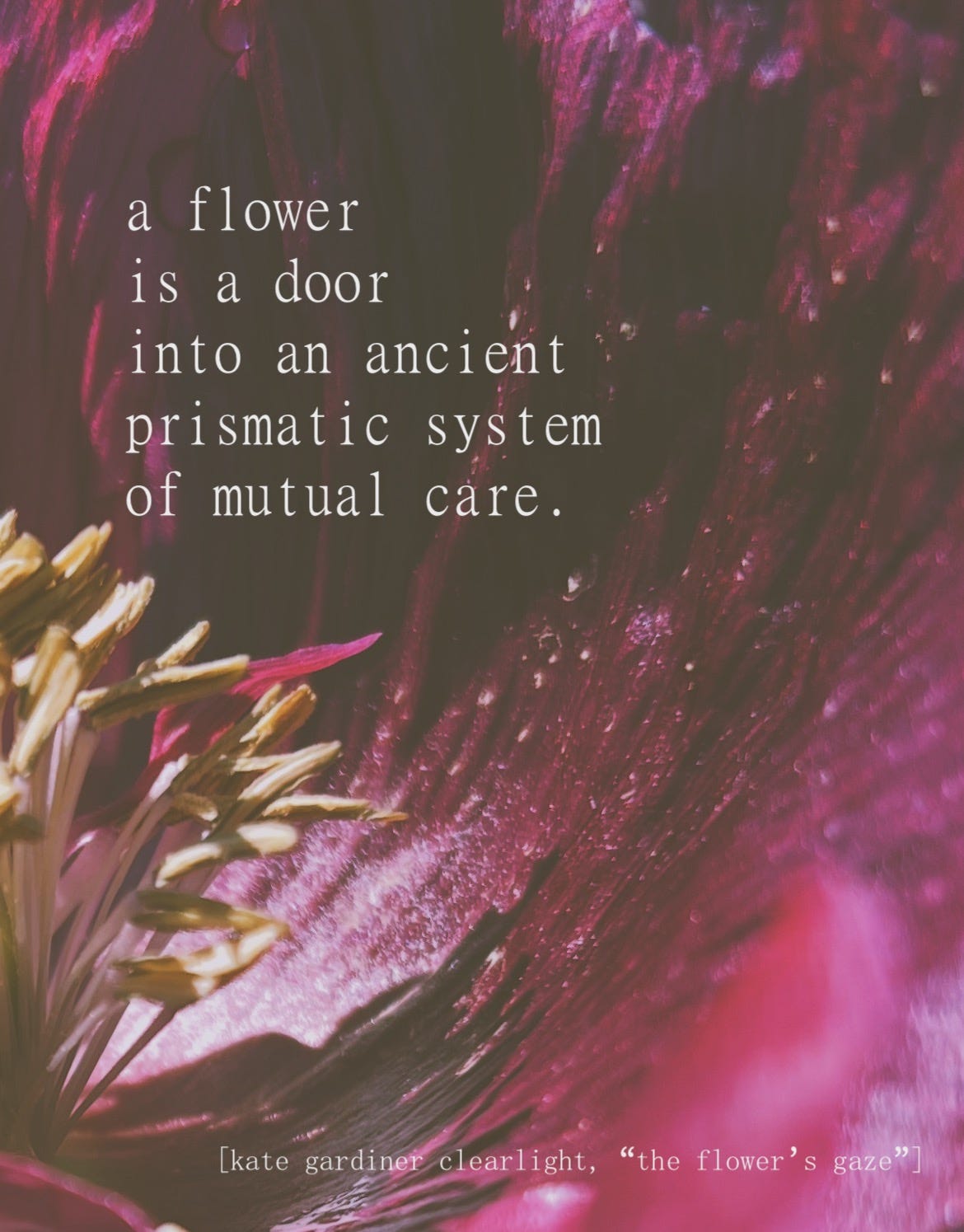
Just as all beauty expressed through Earth is a teacher of attention, flowers are teachers of praise. So are many other wild beings, the moon, the clouds, rocks, our animal companions, babies of all species. Anything you love.
What moves you to speak out loud about your love? What, or who, makes loving feel easy? Take hold of that thread, and don’t let go.
the art of gazing
I have been sharing the practice of “flower gazing” for many years now, because I am in love with this practice. Although it is said to have Taoist roots, it is my belief that the practice is even more ancient and ubiquitous. After all, flowers were here when humans were still just a glimmer of a dream Earth was conjuring. From the dawn of human existence, the flowers have raised us, they made us who we are, and they are here to remind us of our common origins. All we have to do is stop and sit with them.
The curious thing is that I cannot remember who taught me the flower gazing practice. At this point I have begun to accept that it may have been shown to me by the flowers themselves. And it is so gentle, so heart-opening, so radically simple and free, that I feel sharing it is both beneficial and necessary.
The word gaze itself contains within it an essence of praise, doesn’t it? There is a gentle undertone of admiration. There is perhaps even an element of mutuality within it, as though to gaze means the eyes have fallen upon something with its own emanation of consciousness. What does gazing feel like for you? How is it different from looking, staring, or glancing?
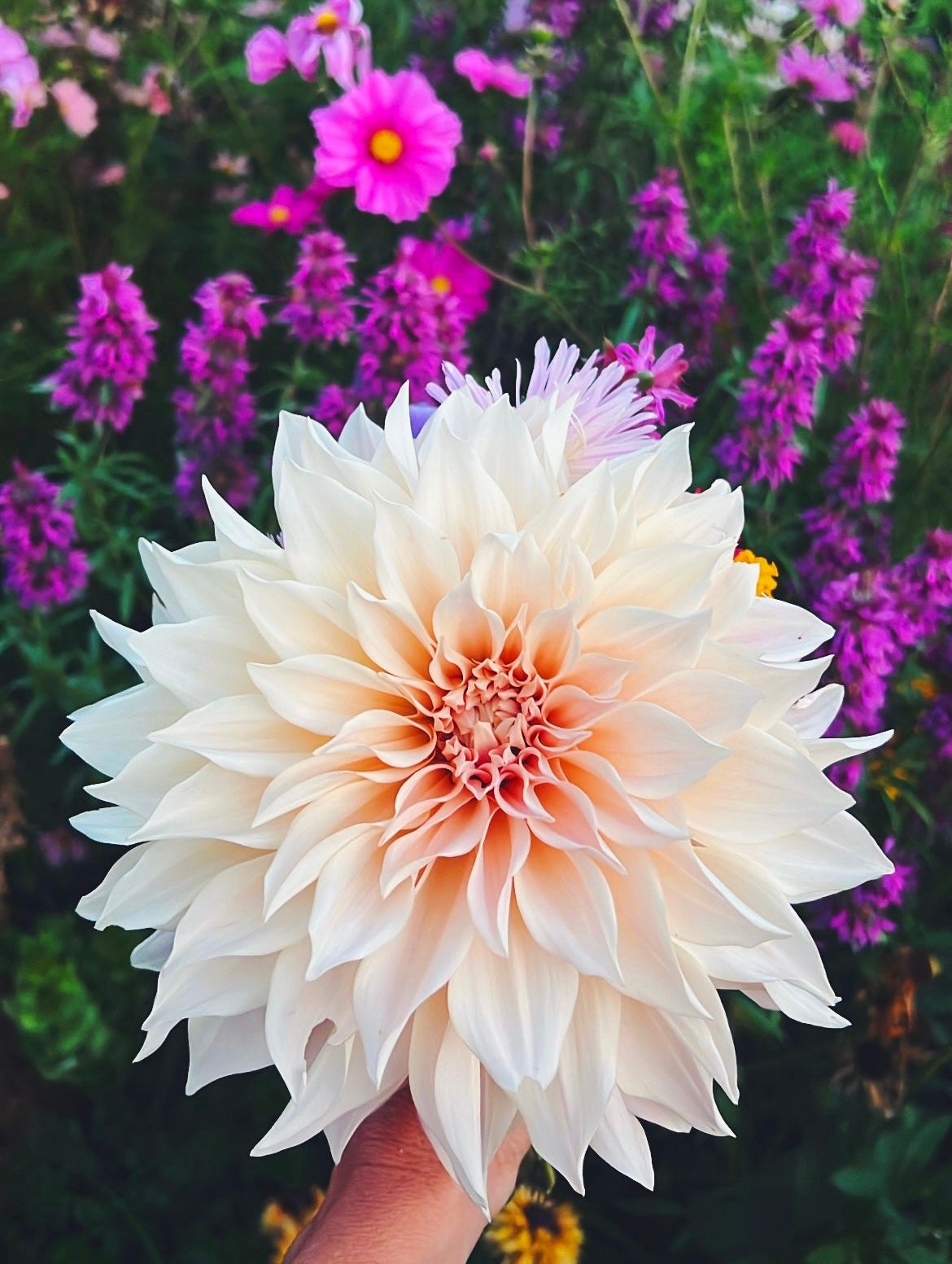
Trataka is a Sanskrit word meaning “to gaze”, and is a meditative technique of gently concentrating on a single object. This practice teaches the mind to not only hold focus, but also to soften the boundaries between Self and Other. It is the practice of both attention and porosity. Many objects can be used for a gazing practice, common ones being a candle flame or a picture of a deity. Or, in this case, a flower.
Because a flower is a conscious being, practicing meditative gazing with a flower is also a gateway into interspecies communication. It is a place where we sit with another life form who appears to be different than us, and we allow the separation between us to dissolve. From that place, we might begin to hear the whispers of the universal heart.
we are not talking about passive agents of transformation;
we are talking about an intelligence, a consciousness,
an alive and other mind, a spirit....
nature is alive and talking to us.
this is not a metaphor.
{terence mckenna}
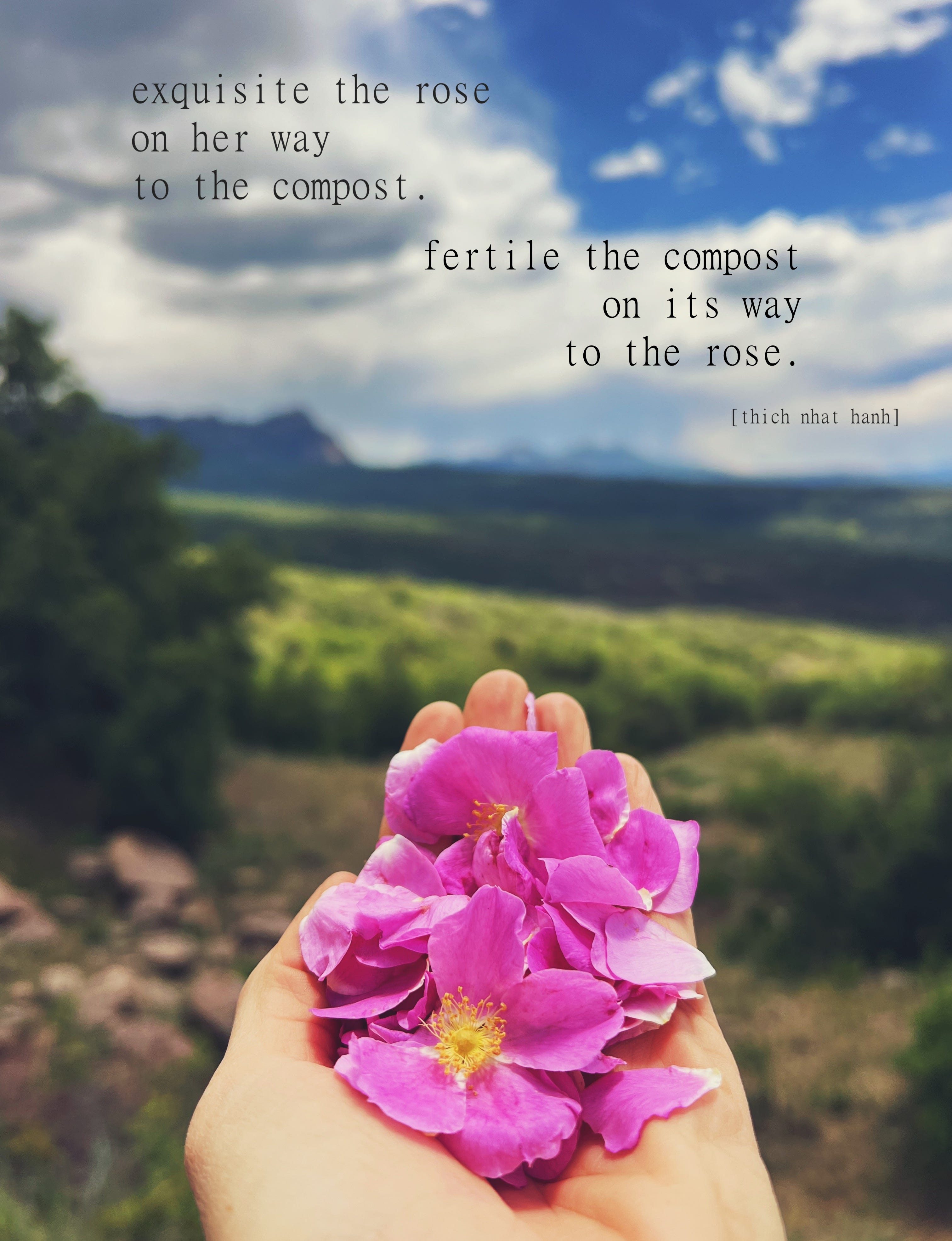
A flower is also a teacher of our own ephemeral nature, and they help us access the inherent grief in being alive. There is vast death wisdom radiating from every flower. They rise gloriously and fall gracefully, somehow making letting go an act of equal beauty.
How many times have you watched a field of radiant blooms, riotous with life, slowly begin to fade before your eyes? How many billions of funerals have been adorned by these fragrant star-petaled teachers? They have been helping us with our grief all along.
When we practice flower gazing, we simply agree to sit quietly for a moment and visit with another life form. We practice offering our attention to another species, and just being with them. Flowers make it easy for us to practice our own most truthful ways of being. There is no need to hold back with the flowers— they certainly don’t. We can practice being ourselves with them, because they provide a safe, open palette to do so. And then we carry that love and tenderness out into the rest of our lives.
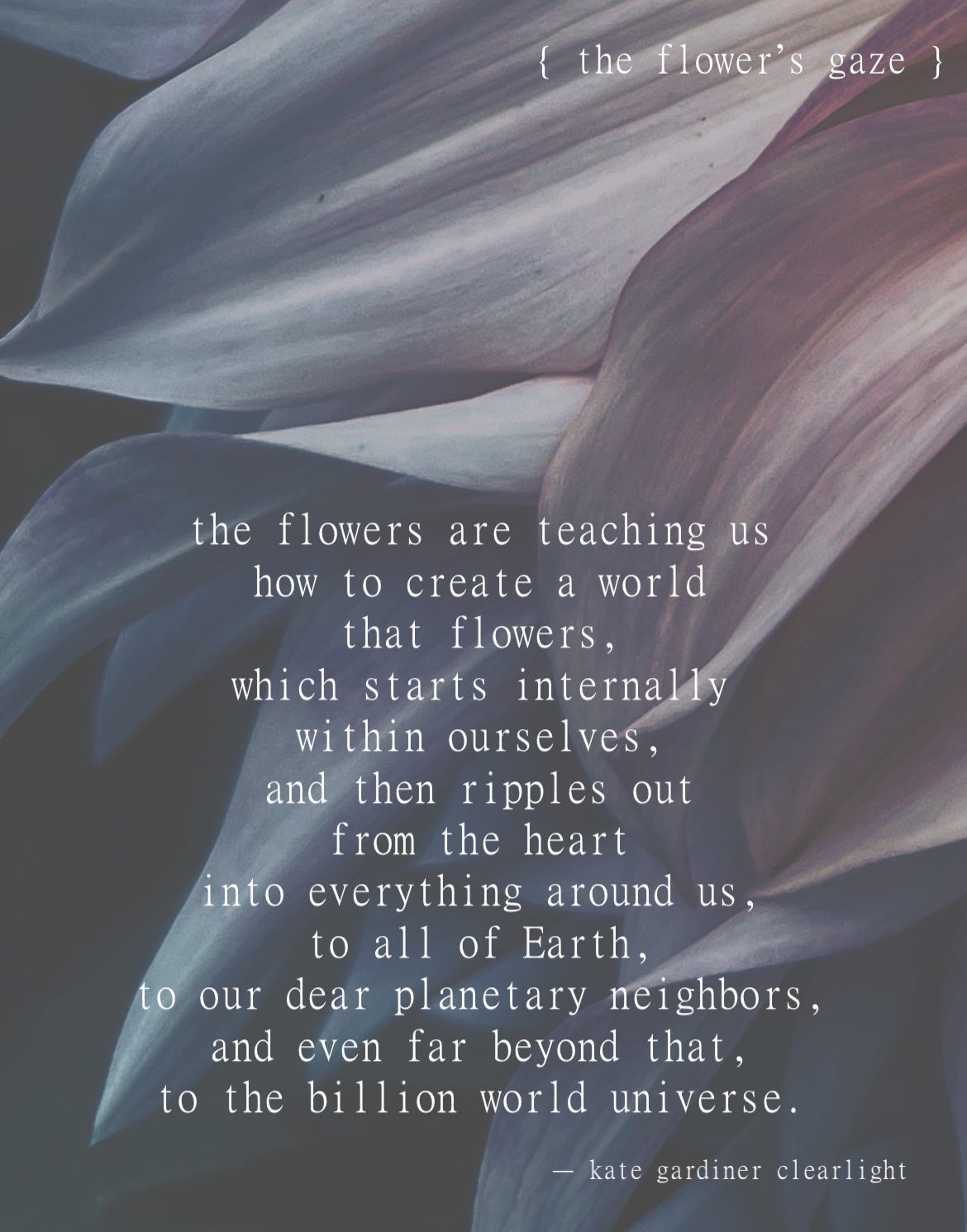
subtle activism for planetary care
What if we each devoted a few minutes each day, until the frost comes, to sitting with these wise old friends and just being present with them? Perhaps nothing will happen, nothing will change at all, and if that is the case, you will be no worse off. But what if something does shift, so subtly within you, that you begin to see new layers of worlds all around you? That you begin to radiate a sort of universal kindness you may have long forgotten lived inside you. What if the simple act of sitting with a flower and just being together, what if this silent, subtle form of activism does change the world?
Does sitting with flowers matter in the scope of this world’s suffering? Could this form of activism, which takes place in the secret realms of one’s own heart, actually be a crucial ingredient in a movement toward change?
It is an impossible paradox, this world we share. There are nuclear bombs being manufactured two hours from my home, on stolen native lands. The people of Gaza are not just starving, but being starved, to the point that our world has finally dared to whisper the word famine. There are thousands of homeless dogs sitting alone in shelters, who will be euthanized before ever getting to share their love with a human. There are lifetimes of reasons to walk around with a hopelessly shattered heart. I know you have your own.
In an aching world, does sitting with the flowers make a difference? How so?
Your response will be entirely unique to you, and it matters. This could be a curious journal prompt, or something to contemplate while sitting or walking outside.
I shape my heart like theirs
and theirs like mine.
(St. Teresa of Avila)
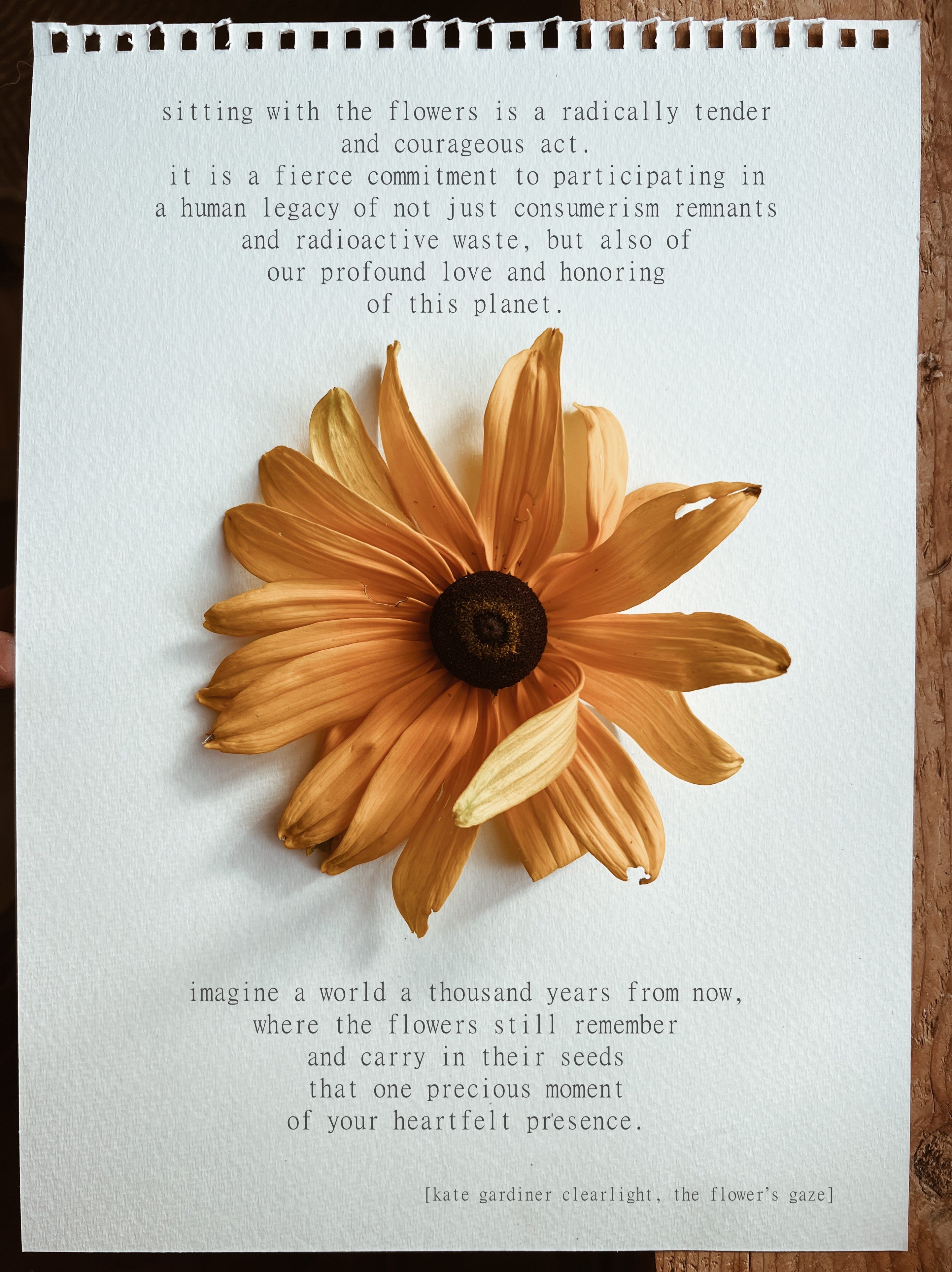
In all my heartache, I will continue to sit with the flowers as a message to Earth that I am still listening. Because I need help learning how to better love this world, and I know she has the secret. I would like to believe that on this very planet, in a thousand years from now, there will still be whispers in the wind about those of us who loved this place, in all its diversity of expression.
The seeds will surely carry forth our stories, long beyond us.
Thank you so much for reading, and for being here with me.
Here are the details of the two audio sessions below, which are the gifts for paid supporters of this newsletter. The sessions are around 1.5 hours of audio and practice:
Part One: the flower’s gaze, intro talk (38 minutes)
An unscripted introductory talk on my own relationship with flower medicine, personal anecdotes, some background on the practice of flower gazing, discussion of single point concentration and samadhi
Part Two: a wild bouquet, group practice session (58 minutes)
foundational practices, explanation and instruction on the following:
seed syllables (starts at minute 7)
lantern consciousness (starts at minute 16)
finding the crystal channel (starts at minute 22)
the main practice: flower gazing & the nondual state (intro begins at minute 30, core practice session begins at minute 41)